

Cold Foam Didn't Come From Vienna: How Trend Reports Rewrite Culinary History
Key Points:
- AI can identify emerging food trends, but human research is still needed to understand the cultural context behind the data.
- Today’s cold foam trend has important connections to Taiwanese tea and bubble tea culture that are often missing from mainstream trend reporting.
- Tracing where food trends come from matters because how we tell stories determines which cultures and communities receive credit for innovation.
- Understanding why consumers embrace a trend requires looking beyond sales and search data to history, culture, and human behavior.
As artificial intelligence becomes increasingly embedded in research, human oversight remains essential for understanding the context behind the data it produces. This is particularly important in food trend forecasting, where consumer behavior is shaped by culture, history, migration, and the exchange of ideas across borders.
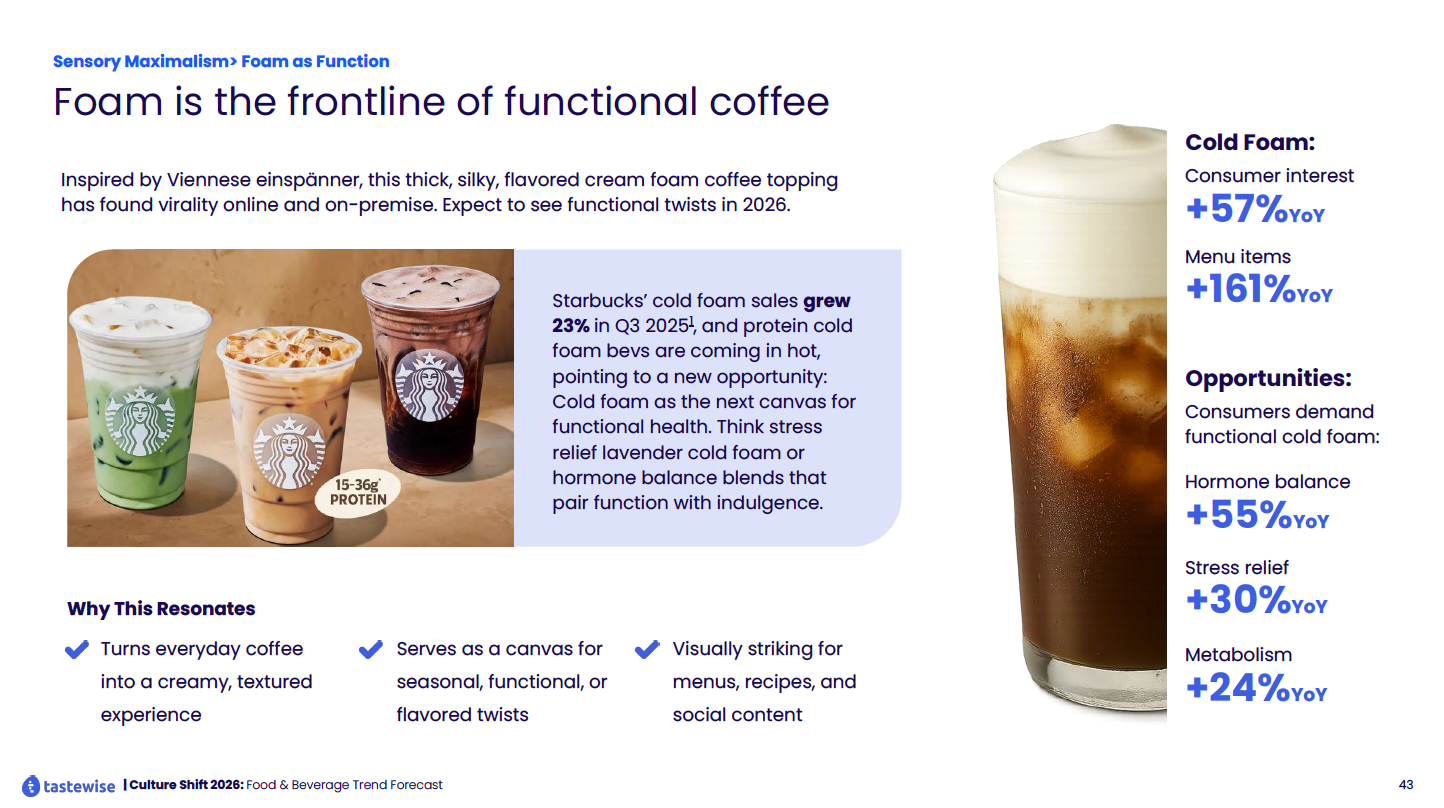
In its 2026 Trend Forecast, AI-powered food intelligence company Tastewise describes the rise of foamed coffee as part of a shift toward sensory maximalism and luxury coffee, highlighting drinks “inspired by Viennese Einspänner”. But cold foam itself is hardly new. Starbucks introduced its Pumpkin Cream Cold Brew in 2019, while cream and cheese foam toppings had already become part of the evolving bubble tea landscape. That raises a larger question: when we identify a food trend, are we also accurately identifying where it came from?
What is Viennese Einspänner?
I had never heard of the term “Einspänner” before I read this report, but after doing a bit of digging, I learned that it is traditionally made of hot espresso or black coffee topped with a thick layer of whipped heavy cream, and was popularized in Austria and Germany in the late 19th century. Google Trends saw a high search interest in the term “Einspänner” over the past few years in the U.S. and globally since its trend in South Korea began in 2023. This version of coffee is being coined, “Korean-style”, but the similarities to its assumed European ancestry are few and far between.
South Korea has a very large and competitive coffee culture creating a culinary hot spot. But the way in which World Food and Wine describes the “Korean version”, distinctly states that the traditional style is the outlier, “Cafés in Seoul’s Yongsan district and beyond have built entire identities around cream-topped drinks, with the Einspänner as the anchor. What is notable is how few Korean cafés serve the hot version at all. The iced Einspänner is the standard; the original is the variation”. It seems the only similarity that this drink has to the historical Einspänner is because the coffee and milk or cream aren’t mixed, and the trend of “cream-topped” drinks has been used in the tea and bubble tea industry for years.
Eurocentrism of Coffee Culture
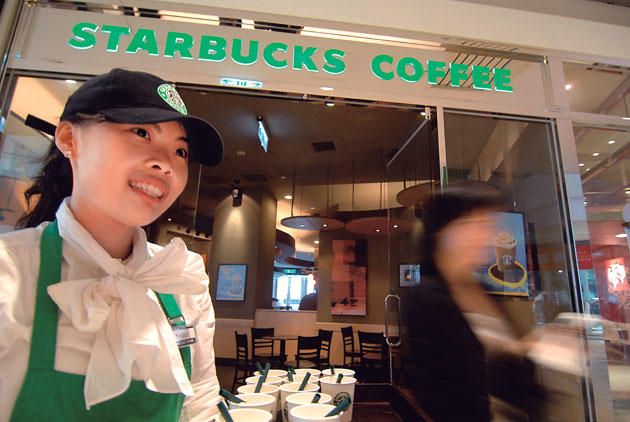
The rise of cold foam beverages is not because Starbucks simply rediscovered an old Austrian coffee tradition. Instead, it reflects a much longer process of adapting Taiwanese tea culture for a global coffee audience. During the 2008 financial crisis, Starbucks faced declining sales, widespread store closures, and layoffs in the United States. As the company searched for new avenues of growth, Starbucks headquarters approved a proposal from its Taiwan team to expand beyond its traditional coffee offerings by introducing premium loose-leaf tea.
Today, beverages such as cold foam matcha lattes and iced coffees featuring flavored foams demonstrate how techniques rooted in Taiwan's tea industry have become central to Starbucks' coffee offerings. The coffee trends that Tastewise states are emerging in 2026 are therefore better understood as the culmination of nearly two decades of investment in Taiwanese tea culture rather than the invention of an entirely new coffee movement. But that's not what the AI-powered Food Influence company is telling the industry leaders. Marketing cold foam as a "long-lost European invention" reinforces a broader pattern of Eurocentrism in the food industry, where innovations rooted in non-Western cultures are frequently reframed through a European lens while the global histories, investments, and communities that shaped them receive far less recognition.
The concept of “foam coffee” is argued online as coming from Korea, Austria and even Sweden. Similar to the argument over who invented the first sandwich, depending on the definition and ingredients, the racial origins can be endless. But the “silky, flavored cream foam coffee topping” that Tastewise refers to, is technically more similar to the Taiwanese style of cheese cold foam believed to have started on the streets of Taiwan in 2010, than that of the Viennese Einspänner in 1800s.
Tastewise states in their report that Starbucks has seen a 23% increase in their cold foam sales in 2025, and now the combo of protein enriched cold foam drinks are connecting their other top trend predictions: luxury, metabolic wellness and sensory maximalism; and most of all, Asian Street Snacks. Which is not mentioned.
The History of Bubble Tea
Lets give credit where credit is due, cold foam comes from the ever evolving toppings associated with bubble tea. Bubble tea is believed to have been created in Taiwan in the 1980s by a street stall owner who sold tea to children after school; today the drink continues to rapidly evolve and is now enjoyed around the world (2012, 51; Jolliffe 2007, 60; Saberi 2018, 203).
Bubble tea recipes are created each year and today bubble tea drinks can be ordered with or without milk, hot or cold, and the drink ingredients continue to shift and change including the newest trend (in 2010's) of enjoying bubble tea topped with whipped cream cheese foam. Tea is a very important product in Taiwan, economically and socially, and bubble tea is understood to be one of the modern streams of the traditional Taiwanese tea house (Jolliffe, 60).
It is claimed that the product development manager Ms. Lin Hsiu Hui, “was sitting in a staff meeting and had brought with her a typical Taiwanese dessert called fen yuan, a sweetened tapioca pudding. Just for fun she poured the tapioca balls into her Assam iced tea and drank it”. When asked why this idea wasn’t trademarked Ms. Lin said, “‘Our main goals at Chun Shui Tang are to promote Taiwanese tea and tea culture and to develop innovative products’”. The decade-long legal battle over the bubble tea patent ended in 2019, when the court ruled that bubble tea could be made and sold by anyone. Yet, Chun Shui Tang staff claim that the brand was the first to sell foam tea, created with a cocktail shaker.
Bubble tea as a product represents Taiwanese identity because it mixes British cultural practice of adding milk to tea, Chinese tea house culture, the Japanese practice of iced tea, and Taiwanese indigenous products such as taro. No matter how bubble tea was invented, the Taiwanese people were able to actively take components from the other cultures of their colonial past, and create something new and distinctly Taiwanese, which supports American anthropologist Richard Wilk’s argument that, “foreign goods create local identity on a global stage”(1999, 14).
Cold Foam is Taiwanese Ingenuity
Bubble tea has become a significant global market, generating an estimated USD 2.75 billion in 2022. Industry projections suggest sustained growth, with an 8.9% CAGR from 2023 to 2030 and an expected market value of USD 6.2 billion by 2032.
Japanese scholar of modern Chinese and East Asian Literature, Fujii Shōzō states,“by actively assimilating the cultural policies imported by foreign regimes, the Taiwanese people under each regime fostered the development of a Taiwanese identity” (2006, 75). Shōzō’s statement about ‘Taiwanese identity’ can be seen through their food, especially bubble tea. Along with the political influences in Taiwan there has historically been a strong push from the Taiwanese tea industry to establish a “Taiwaneses” identity, which helped to create the bubble tea craze. Tea’s integration into the Taiwanese identity relates to anthropologist Richard Wilk’s statement that, “the difficult conundrum of stability and change, of borrowing and diffusion, without growing similarity or loss of identity, which we find in the world’s food consumption, appears in many other realms of culture too”(1999, 1).
Hanzhang Qin captures Taiwan's influence on today's beverage landscape well: "Boba tea's ascent in the American beverage scene is a testament to the nation's melting pot ethos, reflecting how diverse cultural products can find widespread acceptance and success." This perspective stands in contrast to Tastewise's 2026 Trend Report, which champions "Food as Identity Reconnection" yet attributes the rise of foamed coffee primarily to Starbucks and European coffee culture. Missing from this narrative is the story of how Starbucks entered Taiwan, invested in local tea traditions, absorbed regional knowledge, and transformed those innovations into products that could be scaled globally.
By framing the trend through the lens of the Viennese Einspänner without acknowledging Taiwan's role in shaping contemporary cold foam beverages, the report overlooks an important chapter in the evolution of modern coffee culture. If authenticity is truly one of today's defining food trends, then understanding the cultural exchanges, business decisions, and local innovations that shape these products is just as important as celebrating the final beverage itself.
Work Cited
Chang, Derrick. 2017, July 12. Is this the inventor of bubble tea? Retrieved June 21, 2019. https://www.cnn.com/travel/art...
"Enjoy National Coffee Day With a Whipped Cream Einspanner." The Nibble Webzine of Food Adventures, 29 Sept. 2025, https://blog.thenibble.com/2025/09/29/enjoy-national-coffee-day-with-a-whipped-cream-einspanner/. Accessed 7 Aug. 2026.
Gastro Obscura. (2019, April 12). Cheese tea. Atlas Obscura. https://www.atlasobscura.com/foods/cheese-tea
Huff, C. (2024, October 1). The promise and perils of using AI for research and writing. American Psychological Association. https://www.apa.org/topics/artificial-intelligence-machine-learning/ai-research-writing
Jolliffe, Lee, ed. 2007. Tea and tourism: Tourists, traditions and transformations. Vol. 11. Channel View Publications.
Ladd, B. (2019, February 13). Meet Tastewise, the company that knows the next food and grocery trends. Forbes. Forbes
Lucas, A. (2019, August 26). Starbucks is introducing its first new pumpkin beverage since the Pumpkin Spice Latte. CNBC. CNBC article
Ma, Y. (2017, November 17). Taiwan tea in Starbucks: Refining the tea drinking culture. CommonWealth Magazine. https://english.cw.com.tw/article/article.action?id=1729
Makalintal, B. (2024, October 2). The cold foam-ification of fun coffee drinks. Eater. Eater article
Nguyen, T. (2020, April 7). Dalgona coffee, PowerPoint parties, and bread baking: The micro-trends of quarantine. Vox. https://www.vox.com/the-goods/2020/4/7/21207127/things-to-do-during-quarantine-dalgona-coffee-bread-baking-trends
Saberi, Helen. 2010. Tea: A Global History. London: Reaktion Books, Limited. Accessed June 15, 2019. ProQuest Ebook Central.
Schiano, A. (2018, November 28). The science behind cold foam and latte art. Science Meets Food. https://sciencemeetsfood.org/science-behind-cold-foam-latte-art/
Shih, Y.-P., & Chang, C.-H. (2010). The sweet and the bitter of drips: Modernity, postcoloniality, and coffee culture in Taiwan. Cultural Studies ↔ Critical Methodologies, 10(6), 445–456. https://doi.org/10.1177/1532708610372766
Suarez, A. (2022, December 15). Cheese foam tea. Serious Eats. https://www.seriouseats.com/cheese-foam-tea-recipe-6755262
Tastewise. (n.d.). 2026 food & beverage trend forecast. Tastewise
Tseng, E. (2018, September 21). Cheese tea could be the new bubble tea—if Americans get over the name. Eater.
Troisieme Cafe. (2023, July 25). From Nordic origins to global craze: The evolution of cold foam in coffee culture. https://www.troisieme.cafe/blogs/news/from-nordic-origins-to-global-craze-the-evolution-of-cold-foam-in-coffee-culture
Wilk, Richard. 1999. “Real Belizean Food”: Building Local Identity in the Transnational Caribbean. American Anthropologist 101(2): 244-255.
Wong, M. H. (2024, October 20). The origins of bubble tea, one of Taiwan's most beloved beverages. CNN Travel. https://www.cnn.com/travel/bubble-tea-origin-history-taiwan-intl-hnk
World Food and Wine. (n.d.). The Einspänner. World Food and Wine
